


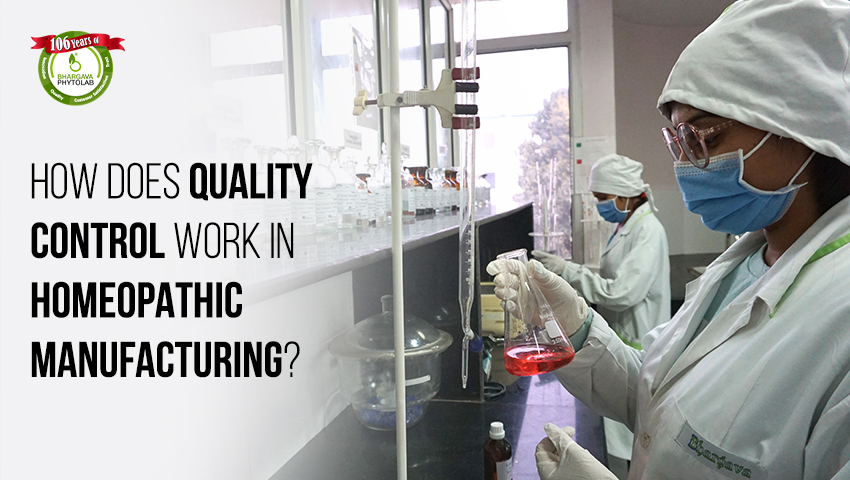
Quality control in homeopathic manufacturing extends far beyond a GMP certificate on a wall. It is a continuous process that begins the moment raw material enters the facility and continues long after a finished remedy reaches a patient. Quality control in homeopathic medicine covers testing, documentation, and verification at every stage of production, including the specific challenge of confirming consistency in remedies diluted well beyond detectable concentration. Bhargava Phytolab, with over a century of continuous operation, illustrate what this process looks like when built into every stage of production rather than treated as a final checkpoint.
How Is Quality Ensured In Homeopathic Manufacturing?
- Raw materials are tested for identity, purity, and adulterants before use
- Mother tinctures are prepared and verified against pharmacopoeia standards
- Potentization is controlled through validated, documented procedures
- In-process checks monitor environment, equipment, and consistency during production
- Finished products undergo batch testing using instruments like HPLC, GC, UV-Vis, and FTIR
- Testing happens in accredited laboratories, ideally NABL-certified
- Packaging, labeling, and storage conditions are checked before batch release
- Pharmacovigilance continues monitoring safety after the product reaches the market
Who Sets The Quality Standards For Homeopathic Manufacturing?
Homeopathic manufacturing quality in India is governed by a framework specific to homeopathy, distinct from conventional pharmaceutical regulation. Schedule M(I), Rule 85-E(2) of the Drugs and Cosmetics Rules, sets the GMP requirements for homeopathic premises, plant, and equipment. This is the basis of GMP in homeopathy, notified in October 2006 and effective from November 2008.
Above the day-to-day GMP rules sits the Homeopathic Pharmacopoeia India (HPI), containing 1,016+ monographs that define identification, quality standards, manufacturing process, and analytical procedures for individual remedies. Internationally, other pharmacopoeias apply their own standards:
| Standard | Region | What It Covers |
| HPI | India | Domestic manufacturing and quality benchmarks |
| HPUS | United States | FDA-aligned pharmacopoeia, 1,300+ monographed medicines |
| BHP and FHP | Europe | British and French pharmacopoeias for regional compliance |
Bhargava Phytolab, holds approvals from Health Canada, NPRA Malaysia, UAE MoH, NAFDAC (Nigeria), and the Tanzania Bureau of Standards, alongside GMP, ISO, HACCP, and HALAL certification, supporting distribution across 40+ countries.
What Are The Steps In The Quality Control Pipeline?
1. Raw material testing and sourcing verification
- Botanical, mineral, or animal-source materials are checked for identity, purity, and adulterants
- Testing is done against HPI monograph specifications
- Only approved, pre-qualified vendors are used, forming the basis of raw material testing in homeopathic manufacturing
2. Mother tincture preparation and testing
- Materials that pass inspection move into maceration, percolation, or decoction
- Strength is checked against pharmacopoeia ratios
- Alcohol content is verified against Extra Neutral Alcohol standards
- Batch-to-batch consistency is confirmed before further processing, together forming mother tincture quality control
3. Potentization and potency testing
- Involves serial dilution and succussion, following Hahnemannian or Korsakovian methods
- At very high dilutions, the original substance can fall below the detection limit of standard analytical instruments
- Potency testing in homeopathic medicine relies on validated process control rather than substance-level detection alone:
- Calibrated equipment
- Precise dilution ratios
- Consistent succussion technique
- Strict adherence to Standard Operating Procedures
- Potentization quality control centers on confirming the process was followed identically, batch after batch
- Bhargava Phytolab’s “Phytotherapy R&D” approach reflects this principle – pairing plant-science formulation knowledge with laboratory-based validation to maintain consistency across 3,000+ formulations
- Some manufacturers now use instruments capable of resolving down to parts-per-billion levels, extending what can be measured at higher potencies, though this remains an evolving area rather than a settled standard
4. In-process quality control
- Environmental monitoring during production
- Regular equipment calibration
- Samples taken at defined intervals
- Every check logged against documented SOPs, so any deviation traces back to its exact origin
5. Finished product testing
- Verifies identity, purity, and batch-to-batch consistency using multiple instruments:
- HPLC – separates and identifies compounds
- GC – analyzes volatile components
- UV-Vis – checks concentration and identity
- FTIR – confirms chemical structure
- Microbiological testing – screens for contamination, particularly in liquid forms like syrups and oral drops
- Testing requirements differ by product type – mother tinctures, potentized dilutions, biochemic tablets, triturations, globules, ointments/gels, and oral or eye/ear drops each carry distinct checkpoints under HPI. Bhargava Phytolab’s catalog spans tablets, syrups, oral drops, and ointments/gels/roll-ons, each requiring its own testing protocol
- A batch-specific certificate of analysis homeopathic medicine document is issued per dosage form, not as one generic record covering an entire line
6. Lab accreditation and testing infrastructure
- Testing credibility depends on the laboratory’s accreditation status
- A NABL accredited homeopathic quality control lab, certified to ISO/IEC 17025, confirms that methods, equipment calibration, and staff competency have been independently verified
- This carries more weight than an unaccredited in-house lab
7. Packaging, storage, and batch release
- Packaging is checked for compliant labeling – batch number, expiry, license number – under the Drugs and Cosmetics Act
- Storage conditions are verified to protect potency
- Quality assurance formally signs off before release
8. Post-market quality control: pharmacovigilance
- Tracks adverse events and complaints after launch
- Feeds into corrective and preventive action loops
- Closes the link between manufacturing and patient outcomes – supported at scale by a wide distribution and practitioner network; Bhargava Phytolab, for example, works with 1,000+ distributors across 1,000+ cities and is recommended by 22,000+ doctors, a network that also surfaces real-world product feedback
How Does GMP Tie The Whole Process Together?
Every stage above operates within Schedule M(I) GMP homeopathic requirements: qualified personnel, documented procedures, calibrated equipment, and traceable records. WHO-GMP certification for homeopathic manufacturing in India, held alongside domestic Schedule M(I) compliance, reflects adherence to both national and international benchmarks. Bhargava Phytolab’s continuous operation since 1920 as R.S. Bhargava Pharmacy – 105 years – reflects the kind of long-term process discipline this framework is designed to sustain.
What Does Strong Quality Control Look Like In Practice?
- Raw materials arrive with supplier documentation already in hand
- Mother tinctures are logged against pharmacopoeia ratios before potentization
- Potentization follows a fixed, validated SOP regardless of shift or operator
- Finished products pass through an accredited lab before a single unit is packed
- The documentation trail from raw material intake to pharmacovigilance can be reconstructed for any batch, at any time
This is the standard reflected in manufacturers like Bhargava Phytolab, where a century of operating history, a broad certification stack, and a formulation-driven R&D approach operate together rather than as separate claims.
Why Do Quality Control Failures Happen?
- Unverified raw material sourcing
- Procedural deviations during potentization
- Incomplete in-process documentation
- Storage conditions that compromise potency
Identifying these issues internally, before a batch ships, is what distinguishes reliable manufacturing practice.
Conclusion
Quality control in homeopathic manufacturing is a continuous chain, not a single certificate. It runs from raw material testing and mother tincture verification through potency testing, finished product testing across every dosage form, accredited lab verification, compliant batch release, and ongoing pharmacovigilance. Bhargava Phytolab, built on over a century of operating history and a broad international certification base, shows what it looks like when each link in that chain is maintained consistently rather than addressed in isolation.
FAQs
How do you test the quality of a highly diluted homeopathic remedy?
Since high potencies can fall below detection limits, quality is verified largely through validated process control – precise dilution ratios, calibrated equipment, and strict SOP adherence at every step.
What does GMP mean for homeopathic manufacturing in India?
GMP in homeopathy refers to Schedule M(I) of the Drugs and Cosmetics Rules, covering premises, equipment, personnel, and documentation, notified in 2006 and effective from 2008.
What is NABL accreditation and why does it matter for homeopathic labs?
NABL accreditation, based on ISO/IEC 17025, confirms that a lab’s methods, equipment, and staff competency have been independently verified – a stronger trust signal than an unaccredited lab.
How is quality control different for mother tinctures versus potentized dilutions?
Mother tinctures are checked for strength and alcohol content against pharmacopoeia ratios; potentized dilutions are verified mainly through documented process control, since the substance may be undetectable at higher potencies.
What happens after a batch is manufactured?
It goes through packaging and labeling checks, storage verification, and a formal QA sign-off before release, then continues to be monitored through pharmacovigilance.


Related Posts

How To Choose A Homeopathic Medicine Manufacturer In India?
Homeopathy has grown into one of India’s most trusted alternative treatment systems, and with that growth comes a wide network of manufacturers offering everything from…
Read More
A Guide to Why Oral Sprays Are Better Than Topical Sprays and Pain Relief Sprays
Pain is a part of life, whether it’s the ache of a long day, an injury, or a health condition. From childhood injuries to adult…
Read More